Dbench.cloud keeps evolving
Dbench.cloud keeps evolving: new benchmarks, new providers, and powerful, DBRE‑friendly architectures are now live. This post walks through what changed and how it can help you make smarter database decisions for your next move.
HammerDB as the new standard
Since launch, one key goal of Dbench.cloud has been to make cross‑provider comparisons fair, transparent, and repeatable. To achieve that, all database benchmarks have now been standardized on HammerDB TPROC‑C tests.
- HammerDB TPROC‑C gives a realistic, OLTP‑style workload that is much closer to real production traffic than synthetic micro‑benchmarks.
- Using a single, well‑known tool and workload means you can compare instances across providers with more confidence and apply the numbers directly to your own sizing and capacity planning.
In practice, this standardization removes guesswork and makes it immediately clear how different instance types stack up on throughput and latency under a consistent load pattern.
Aiven and Ubicloud now available
The provider landscape on Dbench.cloud has also expanded. Alongside the existing hyperscalers, Aiven and Ubicloud have been added as first‑class options in the catalog.
- Aiven brings a rich managed PostgreSQL offering across multiple clouds, which makes it easier to evaluate a multi‑cloud strategy without changing the benchmarking methodology.
- Ubicloud introduces an open, cost‑efficient managed Postgres alternative, especially attractive if you want strong price‑performance while staying away from fully proprietary platforms.
With both providers integrated into the same benchmark and pricing framework, you can now put them head‑to‑head against more traditional cloud offerings and see where they shine.
DBRE‑optimized architectures
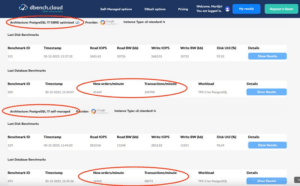
Raw instance performance is only part of the story, so Dbench.cloud now includes a set of DBRE‑optimized architectures that model how real‑world, production‑grade setups look and cost.
- These architectures bundle things like primary/replica setups, high‑availability strategies, and sensible resource allocations so you can estimate the effective performance per euro instead of just per node.
- By comparing architectures instead of individual SKUs, it becomes clearer what kind of resilience, scalability, and operational margin you get for your money.
This shift from “instance‑level” to “architecture‑level” thinking helps bridge the gap between benchmarking and practical database reliability engineering decisions.
A new cost calculator for your next move
To tie it all together, a new interactive cost calculator has been added to Dbench.cloud, designed to guide your next step toward a preferred alternative.
- You can plug in your current or desired workload characteristics and quickly see how different providers, instance sizes, and DBRE‑style architectures impact both performance and monthly spend.
- The calculator brings benchmarks, pricing, and architecture patterns into a single view, making it easier to justify a migration, a right‑sizing effort, or an experiment with a new provider.
Together, the standardized HammerDB benchmarks, the inclusion of Aiven and Ubicloud, the DBRE‑optimized architectures, and the new cost calculator significantly expand what Dbench.cloud can do for engineers and architects preparing their next database move.